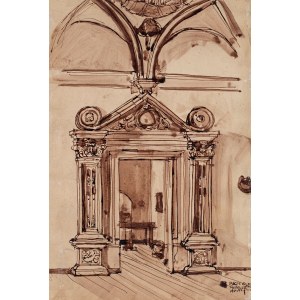
Sepia, cardboard; 42.5 x 32.5 cm
Signed p.d.: BRZEG / MUZEUM 05 / KPKC Jm; on the reverse in pen: Stanislaw Noakowski / 1905 Bacy; stamp: Military Medical Academy / laboratory of scientific documentation / and scientific aids
Asking price 2000
Estimate 3000 - 4000
Stanislaw NOAKOWSKI
1867 Nieszawa - 1928 Warsaw
He studied drawing at the real school in Wloclawek with L. Bouchard. In 1886 he entered the Faculty of Architecture at the Academy of Fine Arts in St. Petersburg, in the upper years in the studio of L.N. Benois. In 1894 he was awarded the Grand Gold Medal for his design of the Imperial Stables (including the title "kłassnyj chudozhnik"). In 1895, as a fellow of the Academy, he went on a tour of Europe. In the same year he made a design for a chapel housing an urn with the heart of T. Kosciuszko at the castle in Rapperswill. In 1899 he took a job at the Museum of Art Industry at the Stroganov Central School of Art Industry where he taught at one point. He also taught at the Moscow School of Painting, Sculpture and Architecture. The influence of Art Nouveau is evident in his work. It was marked in the designs of country mansions and park mausoleums, as well as in the ornamentation of exlibrises. In 1907 he was awarded the Order of St. Stanislaus Second Class. He was a member of the Society of Polish Artists "Sztuka". He designed two tombstones of the Kuyavian bishops for the Wloclawek Cathedral. He developed a series of drawings called "Polish Suite" (in view of World War I, during which many monuments could be destroyed). In 1914 the Academy of Fine Arts in Petrograd granted him the title of academician, and in 1915 he became a full member. In 1918 he was appointed to the Moscow Art College. Upon his return to Poland, he was given a professorship at the Faculty of Architecture at the Warsaw University of Technology (serving as dean from 1920 to 1923). He was appointed to the Museum Council of the National Museum. In 1920 he published the album Polish Architecture - sketches. From 1923 he taught art history at the School of Fine Arts in Warsaw. All the time he created color drawings on European architecture of all eras and styles, also modern projects (for example, cycles of drawing fantasies - evocations of Roman stadiums on the occasion of the Olympics). He exhibited at home and abroad. From 1922 he was a member of the rhythm, from 1924 of the Polish Institute of Fine Arts in Krakow. In 1923, he received a commandery of the Order of Polonia Restituta. In 1926 he received the Prime Minister's Award for lifetime achievement in art.